

BOT for MarTech & UX
Multi-skilled + Flexible engagement + Ready-to-start
Home / Engagement Models / Build-Operate-Transfer (BOT)
Build to Own: A smarter way to scale your MarTech and UX functions without long-term dependency.
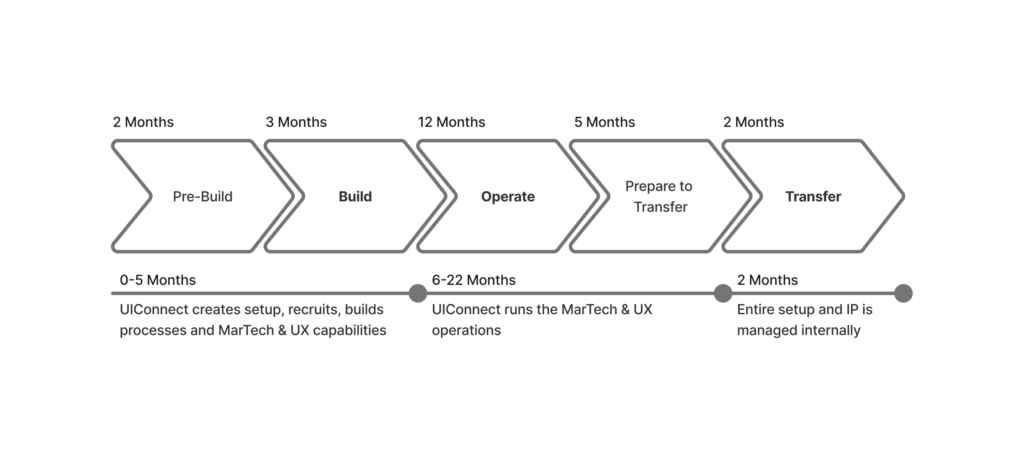
Building a business critical function like MarTech & UX is complex. We can help you setup. Fast.
The Build-Operate-Transfer (BOT) model for MarTech and UX is a structured way to help organizations establish a Center of Excellence (CoE) without needing to build everything in-house from day one.
It starts with building the foundational systems, processes, and frameworks, followed by operating them collaboratively to ensure performance and knowledge transfer. Finally, the model transfers full ownership to internal teams, who are trained and equipped to manage and evolve the function independently. This approach reduces risk, accelerates maturity, and ensures long-term scalability.
- Scale quickly but also retain full ownership of MarTech and UX capabilities
- Reduces risk
- Accelerates setup
- Ensures long-term sustainability
B
Build Phase
Strategy & Setup
- BOT model design and execution roadmap
- Registering new subsidiary and office
- Capability assessment and gap analysis
- MarTech stack selection and UX framework planning
- Governance, compliance, and stakeholder alignment
- Initial infrastructure setup and vendor onboarding
O
Operate Phase
Execution & Optimization
- Platform configuration and workflow automation
- UX research, design system implementation, and testing
- Data pipeline orchestration and analytics setup
- Campaign execution and personalization enablement
- Performance tracking and iterative optimization
T
Transfer Phase
Enablement & Handover
- Process documentation and playbook creation
- Internal team training and onboarding
- Knowledge transfer and support transition
- KPI alignment and operational readiness checks
- Final ownership handover and CoE sustainability planning

1. Foundation Setup (Build Phase)
This phase focuses on laying the strategic and technical groundwork for MarTech and UX capabilities.
- BOT scope, goals, and delivery roadmap definition
- Current MarTech and UX maturity assessment
- Core platforms (CRM, CDP, CMS, design tools) selection and configurtation
- Governance, compliance, and data architecture establishment
- Initial team and align stakeholders onboarding
02. Capability Development
In this phase, the foundational systems are activated, and operational workflows are built.
- MarTech stack evaluation & integration
- CRM, CDP, CMS, and automation platform expertise
- API management & data flow orchestration
- Tagging, tracking, and analytics setup
- Security, compliance, and scalability planning


03. Operational Execution (Operate Phase)
This phase involves running real-world operations while refining systems and enabling teams.
- Campaigns and UX initiatives execution with embedded expert teams
- Performance monitored and workflows optimized in real time
- Usability testing and A/B experiments conducted to validate improvements
- Ongoing support provided to resolve issues and ensure continuity
- Learnings documented to refine processes and prepare for handover
04. Knowledge Transfer & Training
The focus here is on enabling internal teams to take over operations confidently.
- Structured training programs delivered to upskill internal teams
- All documentation, templates, and process guides shared
- Shadowing and co-working sessions to ensure hands-on learning
- KPIs and success metrics alignment with internal goals
- Teams assessed and prepared for independent ownership


05. Ownership Transition (Transfer Phase)
This final phase completes the transition of full control to internal teams.
- Platforms, processes, and governance responsibilities formally handed over
- Operational readiness and capability maturity validated
- Internal support and escalation paths established
- A post-transfer review ensures a smooth transition and feedback loop
- External involvement phased out, and internal ownership fully activated
What BOT Is
- A structured delivery model to build, run, and hand over MarTech & UX capabilities
- A phased approach that reduces setup risk and accelerates maturity
- A way to leverage external expertise while preparing internal teams for ownership
- A method to ensure operational continuity during capability development
- A scalable model for organizations aiming for long-term self-sufficiency
What BOT Is Not
- Not a permanent outsourcing arrangement or managed service
- Not a one-time project - it involves phased execution and transition
- Not a replacement for internal teams - it empowers them over time
- Not a rigid framework - it adapts to organizational needs and maturity
- Finally, not a chatbot or conversational assistant (despite the acronym)
About MarTech & UX BOT
The BOT (Build – Operate -Transfer) model is a phased approach where external experts help set up MarTech and UX capabilities, run them collaboratively, and then transfer full ownership to your internal teams.
BOT accelerates setup, reduces risk, and brings in proven expertise. It allows your teams to learn while systems are being built and operated, ensuring smoother adoption and long-term sustainability.
BOT requires upfront investment in tools, talent, and training. Timelines vary, but most BOT programs span 6–12 months depending on complexity, with clear milestones for each phase.
Yes. Internal teams are actively involved from day one -learning, co-operating, and gradually taking ownership. The goal is to build internal capability, not create dependency.
You’ll have fully operational MarTech and UX systems, trained internal teams, documented processes, and the ability to run campaigns and experiences independently with confidence.
The BOT roadmap is customized to your strategic priorities. KPIs, governance, and workflows are aligned with your business objectives from the start to ensure measurable impact.
Risks like misalignment, delays, or knowledge gaps are mitigated through phased delivery, stakeholder engagement, and continuous feedback. The model is designed to be adaptive and low-risk.

